A Practical Alternative to PLC/ARM/ROS When Speed and Flexibility Matter
Many automation projects still default to a familiar dilemma: “Should it be a PLC?” or “Should it be firmware on an ARM board (or even ROS)?” In a large class of real-world machines—where ultra‑strict hard real-time is not the deciding factor and the product evolves fast—this choice often drives up cost and complexity more than it helps.
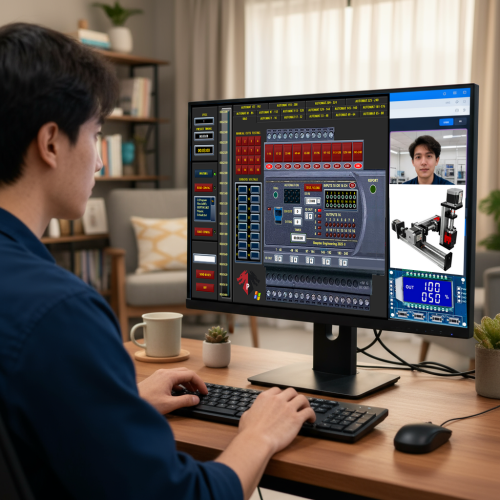
Beeptoolkit is positioned as a universal software platform (an IDE + runtime approach) for building control logic with simple, common, low-cost binary I/O drivers and an extendable I/O organization concept—so teams can focus on machine behavior, not on rewriting low-level control stacks for every new iteration.
Why teams look beyond “classic” control stacks
Even in “simple” machines, most engineering time is not spent on motors or sensors themselves, but on operational scenarios: sequences, interlocks, error handling, service modes, safe stops, and constant small changes after first tests.
Typical trade-offs look like this:
PLC projects can be very effective, but they often depend on specialized vendor tooling and niche expertise, and iteration speed can depend heavily on who owns the project and the environment.
ARM/embedded approaches can be powerful, but changes in behavior can quickly turn into more firmware work, drivers, update mechanisms, and deeper debugging cycles.
ROS/ROS2 can be excellent for complex robotics, but it may be excessive for machines whose core value is clear, deterministic behavior rather than a large distributed robotics stack.
What Beeptoolkit is (in plain language)
Beeptoolkit is described as a multi-industry automation and robotics R&D platform built around understandable behavior design: states, transitions, timers, and signals. Instead of treating control logic as “only code,” Beeptoolkit treats it as an explicit model of machine behavior that is easier to build, review, and evolve.
A key idea is straightforward: many machines can be controlled using common binary logic devices (“on/off”, “open/close”, “present/not present”), connected through extendable I/O, and orchestrated by a software control layer on a standard PC-class setup. This approach is especially attractive for custom machines and small-batch builds, where rapid changes and customer-specific adaptations are normal, not exceptional.
A balanced comparison (no “holy wars”)
This is not about declaring one technology “best.” It is about selecting the fastest, most maintainable path for projects where flexibility and iteration speed dominate.
| Decision factor | PLC | ARM / embedded | ROS/ROS2 | Beeptoolkit |
|---|---|---|---|---|
| Entry complexity | Medium to high (industrial tooling + vendor specifics) | High (firmware, drivers, update/diagnostics) | High (ecosystem + robotics architecture) | Lower for behavior work (state-based logic and signals-first mindset) |
| People cost risk | Can require niche PLC specialists | Embedded specialists are broadly available but expensive when deep experience is needed | Strong ROS engineers can be scarce for industrial MVPs | Fits general automation/software profiles better when hard real-time is not critical |
| MVP iteration speed | Good if the team already lives in that PLC stack | Often slower due to low-level work | Great for complex robotics, often too much for simple machines | Designed for fast behavior changes and evolving scenarios |
| Fit for custom/small-batch | Good, but tooling constraints may slow changes | Good, but development overhead is high | Varies; best when robotics complexity is the driver | Strong fit: rapid customization and logic evolution as a primary goal |
When Beeptoolkit is a strong fit
Beeptoolkit tends to be a strong choice when the machine is defined by clear sequences and binary I/O signals—and when “change” is expected: new modes, revised service logic, updated workflows, or customer-specific variants.
It is especially relevant if these statements are true:
Hard real-time is not the deciding advantage for your product.
You build custom or small-batch machines, and each new client may require tweaks.
You value transparent, easy-to-review control behavior as a project artifact (not just buried inside code).